
Natural mineral water vs spring water: what are the differences?
Although they are often used interchangeably, natural mineral waters and spring waters differ significantly in terms of their geological origin, characteristics and regulatory framework.
What is the difference between mineral water and spring water?
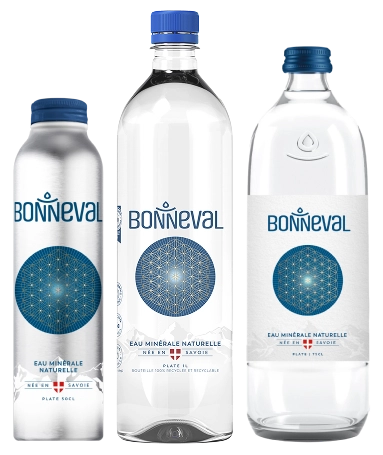
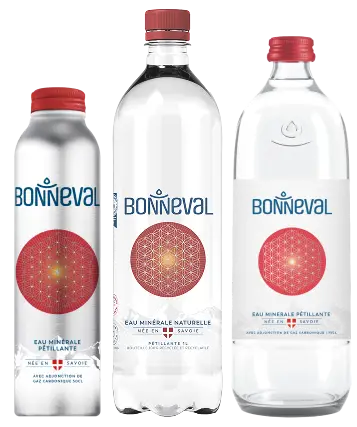
Natural mineral water and spring water both come from a protected underground source, but differ in terms of their stability and official recognition. Natural mineral water is characterised by a composition that remains stable and constant over time, ensuring it provides health benefits regardless of the season or the date of extraction. Bonneval mineral water is naturally rich in minerals, particularly calcium and magnesium.
It has been officially recognised by the health authorities following several years of rigorous analysis, and its stability is guaranteed, just as it has been for thousands of years whilst embedded in the Alpine rocks.
Conversely, spring water, although safe to drink as soon as it emerges, may vary slightly in composition depending on when it is collected.
As it is less strictly regulated than mineral water, it cannot claim to have any specific health benefits, but it remains a reliable and affordable option for everyday consumption.
All about bottled water: the benefits of spring water compared to mineral water or purified water
Natural mineral water is a valuable alternative to tap water, particularly because it is rich in essential minerals. It therefore meets specific needs, whether for active people or older people. Certain mineral waters are also recommended for digestive or metabolic disorders.
Spring water, which generally contains fewer minerals, is ideal for simple, everyday hydration. Its lightness makes it a drink suitable for all diets.
Purified or enriched waters, on the other hand, undergo treatments designed to remove impurities as well as minerals. Whilst they are highly neutral, they do not provide the specific mineral benefits offered by naturally sourced waters such as mineral water. They may be useful on an occasional basis, but do not offer the benefits of naturally balanced water.
What should you look out for on water bottle labels?
It is essential to check the source of the water, its mineral content, and whether it is enriched with specific elements such as calcium, magnesium or sodium.
Dry residue (expressed in mg/L) is a good indicator of the mineralisation of water.
For everyday consumption, water with a low mineral content is generally sufficient. However, for specific needs, such as muscle support or bone health, a formula rich in minerals may be beneficial.
Another point to consider is the choice of packaging. Today, most plastic bottles are recyclable, and their life cycle is increasingly aligned with the principles of the circular economy. Lightweight, durable and requiring little energy to recycle compared with other materials, plastic is a practical and responsible solution when chosen thoughtfully.
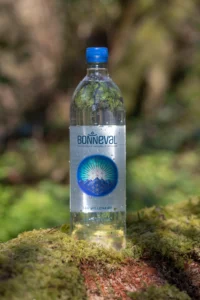
Storage for better water quality
To ensure the best possible quality, it is recommended that you store the bottles away from heat and direct light. Following good storage practices will help to preserve all the water’s qualities, whilst also benefiting from modern, environmentally friendly packaging.
Water stored in unsuitable conditions can affect its taste or quality, even if it is properly bottled.
Tailoring water to your needs
It is important to choose water that suits your needs. For example, someone who is active or plays sport might prefer water rich in magnesium, whilst an elderly person might drink water rich in calcium to strengthen their bones.
Children, who are still growing, have specific needs. Light water, low in sodium and containing moderate amounts of essential minerals, is often recommended so as not to put too much strain on their still-developing kidneys. Regular hydration is essential for their overall well-being and vitality.
Pregnant or breastfeeding women may also benefit from water that is naturally rich in calcium, subject to medical advice.
Spring water is ideal for daily hydration, whilst natural mineral water can be chosen for its specific properties. Please feel free to consult a healthcare professional to determine which water is best suited to your needs.
Because, beyond simply providing hydration, certain types of water can support a specific lifestyle or health condition.
Why choose a natural mineral water that is rich in minerals?
Choosing a water such as Bonneval means opting for a truly exceptional water. Sourced from the French Alps, it has flowed through Alpine rock for thousands of years, thus avoiding any pollution. During this journey, it becomes enriched with minerals and trace elements that are beneficial to health.
This slow, natural filtration process acts as a biological purifier, producing stable, high-quality water with a unique taste.
Its stable formulation and original purity make it the preferred choice for those seeking the benefits of natural compounds. Furthermore, bottling drinking water directly at the source ensures that the minerals are optimally absorbed.
This ensures the water remains fresh and that its physical and chemical properties are preserved.
Bonneval: a French water brand with its origins in the Alps
Bonneval water comes from the French Alps, specifically from the area known as ‘Bonneval-les-Bains’ in the commune of Bourg-Saint-Maurice in Savoie. It flows naturally at a temperature of around 28°C, having travelled through Alpine rock for thousands of years, slowly becoming enriched with minerals.
Bonneval also offers glass bottles, an environmentally friendly choice that preserves the water’s quality whilst reducing the use of plastic. The brand is also innovating with a 10-litre Bag-in-Box (BIB) format, a practical and eco-friendly solution, ideal for the home, the office or extended stays. This packaging reduces the carbon footprint associated with transport and packaging, whilst extending the water’s shelf life thanks to its airtight pouch, which protects it from air and light.
Transparency and quality: Bonneval’s commitments
Bonneval is committed to preserving its water resource by limiting water extraction to 20 per cent of the spring’s capacity, thereby ensuring the resource’s sustainability. The water is regularly tested to ensure it complies with strict health standards, so that it retains its designation as natural mineral water.
These commitments reflect a commitment to balancing quality, responsibility and respect for our natural heritage.
By choosing Bonneval, you’re opting for a way to stay hydrated that’s kind to the environment and good for your health.
At a time when water pollution is becoming a global concern : microplastics, nitrates, pesticides and other contaminants. The unspoilt, underground source of Bonneval water offers a genuine guarantee of safety. Protected from the surface, it is free from human-caused contamination. With no illegal treatment whatsoever, it is pure and rich in minerals. This is in contrast to tap water or water treated by filter jugs, which remain exposed to external contaminants.
It thus represents a return to basics, an authentic source rich in minerals, in an increasingly artificial world.
Making the right choice : French-sourced and for everyday use
Not all bottled waters are the same, as their mineral compositions vary: some offer a richer and more consistent composition of beneficial elements, whilst others are lighter and suitable for everyday consumption without any specific requirements. Understanding where the water comes from and taking into account the quality controls carried out enables you to choose a water that suits your lifestyle, preferences and mineral requirements.
Choosing your water is an informed decision that balances personal wellbeing with respect for the environment.
Whether you choose natural mineral water or spring water, it is essential to understand the differences between them and to choose the one that best suits your needs. Bonneval water has a stable composition and is rich in minerals, making it a sensible choice for those seeking healthy, natural hydration.